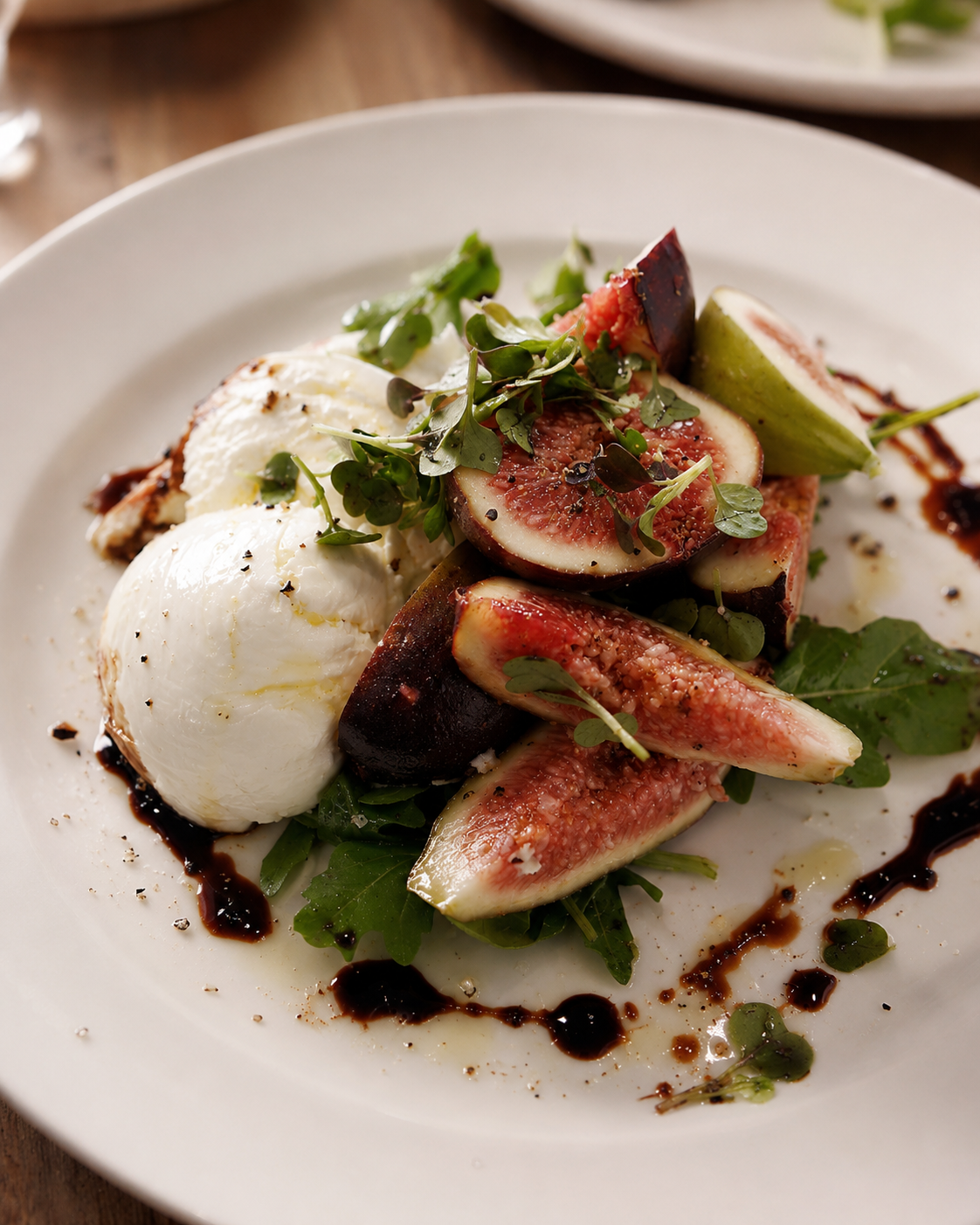
This is one of our go-to sharing plates that is ideal for entertaining. We often use this as a side dish or a starter (with a glass of bubbles!) and it generously serves 4. It is super quick and easy to prepare and absolutely heroes the figs and cheese. It’s sweet, salty, peppery and creamy – so good! We often serve ours with a flatbread, some toast or even a cracker. Whatever suits your mood!
Ingredients
Scale
2 large size balls of fresh burrata (an Italian cows milk cheese), drained and kept whole 8 figs, cut 2 of them in half and 6 into quarter wedges. teaspoon of brown sugar small knob of unsalted butter A bunch (or small bag) of fresh rocket (arugula) leaves – washed & drained thoroughly 1 tbls of extra virgin olive oil 1 tbls of balsamic vinegar salt & black pepper micro herbs for garnish (optional)
Instructions
On a large plate, place the burrata balls
In a small fry pan, heat the small knob of butter
Take the 4 halves of fig and dip them into the brown sugar to lightly coat
Place sugar side down into pan and gently fry until they caramelise.
Lay the rocket onto the plate next to the burrata
Add the caramelised figs on top of the rocket
Now arrange the remaining quartered fresh figs on top
Mix the olive oil and balsamic vinegar together and drizzle over entire plate
Season with salt & pepper and add micro herbs to garnish (optional)
Enjoy!
Notes
We buy our fresh burrata from our local Italian deli. Some supermarkets stock it also, just always ensure it is fresh!
Rocket/arugula leaves are so important in this dish as they add a peppery, earthy taste.
Use the best quality EVOO and balsamic vinegar that you can find.
This is a staple here at maison HQ. As a LOVER of peas we’ve tried sooooo many recipes and techniques, but we keep coming back to this one. Fresh, vibrant and the ideal brunch or lunch. The peas work superbly with the tangy chimichurri drizzled over them, and the crunch of the toast. Super easy and tasty.
Serves 2
Ingredients
Scale
1cup frozen baby peas (we like baby peas for their sweetness)1 lemon – for zesting, juice and a segment 1 burrata ball (an Italian cows milk cheese) – drained and gently torn into segments 1 small knob of unsalted butter 2 slices of toast (we love sourdough or rye) lightly buttered (optional) for Chimichurri:1 small bunch of flat leaf parsley leaves chopped finely (reserve a couple of leaves for garnishing) 2 finely minced (or grated) garlic cloves 1 tbs red wine vinegar 2 tbs extra virgin olive oil 1/2 tsp dried oregano a pinch of salt (or alternatively, we love to use an anchovy fillet) a pinch of white pepper a pinch of chilli flakes (optional)
Instructions
In a food processor (or mortar and pestle) combine all of the chimichurri ingredients till just blended and set aside for the flavour to enhance whilst you prepare the peas
Place frozen peas into a hot pan with the small knob of butter and toss until just cooked through and liquid evaporates (or alternatively you can steam them in boiling water for 2-3mins and drain). Either way, you want the peas to still be green and vibrant – don’t overcook!
Whilst peas are cooking, lightly toast your bread
Remove half of the peas from pan with a slotted spoon, place into a bowl and gently mash with a fork.
Add remaining peas to mixture and stir through half of the chimichurri mixture and a small amount of lemon zest and a squeeze of lemon juice (optional). Season to taste.
Spoon the pea mixture onto each slice of toast
Top with equal amounts of torn burrata cheese
Drizzle over remaining chimichurri sauce
Garnish with some of the remaining whole parsley leaves and a small wedge of lemon
Enjoy!
Notes
We buy our burrata from our local deli. Some supermarkets stock it as well.
Don’t overcook your peas! They need to hold little bit of bite for texture and remain vibrant in colour
Season your chimichurri to taste – we love ours quite zesty and tangy and sometimes with a bit of chilli flakes, sometimes without. Up to you! Be mindful if you use an anchovy fillet – you won’t need to add salt as well
We love a little bit of white pepper in our chimichurri too, but this is optional
This delicious cake is best served warm and when rhubarb is in season. It has such a distinctive sweet and tangy flavour and is an elevated version of a simple apple crumble. To note: Please ensure that you discard all of the rhubarb leaves – they are toxic and inedible. They contain high concentrations of oxalic acid and anthraquinone glycosides.
Serves 6
Ingredients
UnitsScale
for cake:1 bunch rhubarb stalks (leaves must be fully discarded – see above) – before using the rhubarb please be sure to cut off any brown bits at the end of each stalk, wash, dry & trim thoroughly and then cut into approx. 3cm pieces. 2 green apples, peeled, cored and sliced 110gcaster sugar90gunsalted butter at room temperature2 eggs, lightly whisked 75gself raising flourPinch of salt 1 tbs extra self raising flour 2tbs milk for crumble:50gplain flour60gbutter, cold and cubed2tbs light brown sugar icing sugar to serve Creme fraiche or vanilla ice cream to serve (optional)
Instructions
Preheat over to 190 degrees celsius (374 Fahrenheit)
Grease a 20cm springform cake tin
Prepare crumble topping by sifting flour into a bowl and rubbing in the butter until it resembles coarse sand in texture. Stir in light brown sugar and set aside. (If you prefer, you can also prepare this in a food processor)
Combine the rhubarb and apple with 1tbs of the caster sugar and mix well. Set aside.
In a mixer (or with a hand mixer), beat the butter until creamy in texture. Add the remaining sugar and beat until light and fluffy
Add the eggs in two stages; beating well after each addition. Add the extra tablespoon of flour now to prevent the butter and eggs from separating
Sift the flour and salt into the butter mixture and fold together. If the mixture is too dry, add a couple of tablespoons (maximum) of milk to loosen it up a little
Spread the mixture into the cake tin. Cover with the rhubarb and apple mixture and then the crumble topping
Bake for 1 hour and 15 minutes until the top is golden and a skewer or toothpick, comes out clean
Let cool on a wire rack and dust with icing sugar
Slice into generous servings and add ice cream, creme fraiche or thickened cream to serve
Notes
Please ensure that you discard all of the rhubarb leaves – they are toxic and inedible. They contain high concentrations of oxalic acid and anthraquinone glycosides.
A good risotto has a way of making any day feel just that little bit more special. This one is simple and easy to love, with leeks, mushrooms and peas. You can modify it to your taste, as this is a versatile base that starts with just a handful of simple, quality ingredients.
This recipe serves 2 (generously) as a main, or 4 as a side.
Ingredients
UnitsScale
1 leek rinsed and finely chopped 150g white or brown mushrooms, sliced1 large garlic clove, peeled and finely chopped 3/4cupaborio rice1/4cupdry white wine1litre chicken or vegetable stock (we use low salt or unsalted as we prefer to control the seasoning)1 bunch of asparagus, trimmed and cut into small pieces 1/2cup frozen peas (we prefer baby peas as they add a lovely sweetness)2 tbsp olive oil 1/2 lemon, juiced 1 tbsp butter (we prefer unsalted for this recipe) 1/4cupparmigianoregiano (parmesan) cheese (or we also use Grana Padano)Freshly ground sea salt and pepper to taste finely chopped parsley for garnishing (optional)
Instructions
Heat the stock in a saucepan over medium heat to bring to a gentle boil. Then turn the heat down to a simmer
Add 1 tbsp of olive oil to a large saucepan, add the mushrooms and fry over medium to high heat until golden (approx. 5-7min). Remove with a slotted spoon and allow to rest.
In the same saucepan, add 1 tbsp of olive oil into a saucepan over medium heat. Add leek and garlic and gently saute till translucent (approx 3 min, being careful not to burn them)
Once leek and garlic is translucent, add rice and continually stir for 1-2 min to coat each grain. This process is called ‘tostatura‘ (toasting) and is an important step in providing the nutty flavour and creamy texture to the finished risotto.
Add the dry white wine to the hot pan to deglaze the rice. Stir through until it is fully evaporated and the aroma of the wine disappears. This process is called ‘sfumatura‘
Add one ladle at a time of the broth to the pan and stir until fully absorbed. Continue this process one ladle at a time until all of the broth is absorbed and the rice moves in a nice ‘wave’ through the pan when you run your spoon through it. The texture of the rice should be slightly chewy but creamy. This process takes approx. 20 minutes
Add the aspragus and peas and stir through till just cooked. Don’t overcook the vegetables. You want them to remain their vibrancy of colour and texture. Approx 3-5 min
Add the mushrooms back to the pan and gently stir through to combine.
Remove pan from heat and immediately stir through the butter and cheese to get a creamy consistency
Season with salt and pepper to taste and the squeeze of lemon juice
Let the risotto rest for a couple of minutes so all of the flavours blend together.
Serve with a light drizzle of olive oil and finely chopped parsley to finish
Notes
Always ensure your broth is warm before it is added to the pan
It’s important to stir your rice with each ladle, but no need to over stir continuously as this can make the risotto feel ‘gluggy’ as it releases too much starch
If your risotto feels too dry, add a little more (heated) stock to the pan and stir gently to loosen
If the risotto is sticking to the bottom of the pan, turn the heat down slightly and continue stirring to loosen
This base recipe is incredibly versatile – ie. you can add roasted pumpkin instead of mushrooms, substitute the leek for onion, add diced bacon or pancetta etc. Once you know the basics of a good risotto, you can modify it to suit!
If you don’t wish to use wine, you can substitute with a little bit of lemon juice at this stage of the cooking process (to provide the acidity required), or alternatively you could use a non-alcoholic white wine.
A delicious and simple baked cauliflower that is elevated to another level! Perfect as a side dish to steak, chicken or fish, or as a standalone main course served with rice or salad.
This recipe serves 4.
Ingredients
UnitsScale
1 large cauliflower – outer leaves removed (we love to leave just a couple) and base trimmed 1 tbsp extra virgin olive oil 1 tbsp of miso paste of choice 1 tbsp light soy sauce 2 tbsp honey 500ml chicken or vegetable stock (we use low salt or unsalted as we prefer to control the seasoning)juice and zest of 1 lemon Grated knob of fresh ginger (optional) sprinkling of sea salt and black pepper (to taste)
Instructions
Preheat oven 180°C (degree Celsius) or 356°F (degree Fahrenheit)
Trim and rinse cauliflower and leave whole
Place cauliflower in a deep baking / casserole dish (with lid)
Combine all remaining ingredients into a jug and mix well.
Pour over the cauliflower, making sure to coat well.
Cover with foil and lid and place into oven. Bake with lid on for approx. 40 min
Check if cauliflower tender with a knife in centre. If tender, remove lid and foil and baste with juices from pot.
Increase heat to 200°C (degree Celsius) or is 392°F (degree Fahrenheit) and place back into oven and bake until golden and slightly caramelised – another approx 20min.
Remove from oven and transfer to plate for serving. Spoon over remaining sauce.
Notes
We love to add a drizzle of extra virgin oil before serving and a good grind of black pepper
Go lightly on the sea salt as the soy sauce provides enough saltiness!
A deliciously creamy (minus the cream!) and hearty bowl of cannellini beans that you will want to serve with crusty sourdough and perhaps some spicy sardines…this is a favourite of ours to serve as a late breakfast / brunch or lunch dish. It’s so quick, easy and incredibly tasty!
Serves 2
Ingredients
UnitsScale
For beans:1 can (approx. 420g or 15-16 ounce) of cannellini beans (see notes), drained and rinsed 1 garlic clove, finely chopped, minced or grated 1 lemon – zest and juice 1 tbsp extra virgin olive oil 500ml of chicken or vegetable broth or stock (we use low salt or unsalted as we prefer to control the seasoning)50g of grated parmesan cheeseFor gremolata:1/2 bunch of flat leaf parsley 1/2 clove garlic lemon zest of one lemon and a small squeeze of juice 1–2 anchovy fillets (optional) 1 tsp extra virgin olive oil Salt & freshly ground black pepper to taste
Instructions
To make the gremolata, mix all of the ingredients in a small blender, or we prefer to use a mortar and pestle. Whichever method used, try not to over blend – you want to keep some texture. Once made, check seasoning and adjust to taste (should taste zesty and fresh – and not too salty). Set aside
To make the beans: place a little of the extra virgin olive oil into a medium size fry pan over medium heat
Add the garlic and saute till translucent – a couple of minutes (be careful not to burn or colour!)
Add the beans and stir through – a couple of minutes
Add half of the stock and simmer the beans until softer (approx. 5 min)
Take a masher (or the back of a large wooden spoon) and gently pressed down on the beans so that some are slightly mashed (this process helps give the beans their ‘creamy’ texture)
Add the lemon juice and remainder of stock
Simmer for another 5 minutes or until the beans have a softer, creamy consistency.
Remove from heat and add in the parmesan cheese and stir to combine (and until cheese is melted)
Season with freshly ground black pepper and salt
Serve in a bowl, topped with gremolata and sourdough bread, lightly toasted for dipping!
Notes
We prefer to use canned organic cannellini beans whenever we can
We love to serve these beans with a side of spicy or smoked sardines!
If you love a bit of extra spice, a splash of green or red tabasco sauce is also fantastic with this dish.
Prep Time:15 min
Cook Time:15 min
Category:Breakfast, Dinner, Lunch, Side Dish, Snack
“I’m definitely not fearless. But I am courageous. It’s not something I wake up with – I have to choose it. Somedays, more often than others. But I learnt long ago, fear doesn’t go away – I just had to find the courage to keep going in the face of grief, doubt, reinvention.”
creator of maison 1973, Nic Tierney
Courage Is Not The ABSENCE Of Fear.
I’ve felt varying degrees of fear in all sorts of situations – airports, boardrooms, hospitals. I’ve felt it in my bones. I’ve felt it before sending the text, the email. Making the call. Starting again. Walking away. Small things, big things – all sorts of things. Over time, I have been fearful of many things – I am human.
And I’ve felt fear when things were good, too. When life was full and love was all around and it scared me because…what if I lost it?
So no – I’m not ‘fearless’. But I try not to let fear ever take over and stop me from doing what I need – or want to do. I also don’t live in a state of fear – something I am incredibly grateful for.
Fear – it visits me.
The word, the context, the emotion and the meaning behind it, truly fascinates me – as often it is just thrown around very one dimensionally without thought or care for what it actually means to some people.
Like you, I have to face things I fear all the time. How do I do that? By finding courage.
I’ve just stopped pretending that ‘fearlessness’ is the goal. But courage? That’s real. That’s lived. And that’s what midlife is asking of us now as we embark on our next chapter.
Fear Doesn’t Mean You’re WEAK.
We’re told from a young age to be brave. To stand tall. To not cry. And often, when we learned how to find the courage and face a fear – we grew as a result. Fear can be one of our greatest teachers. I am not ashamed at all to admit that I have many fears – some I have faced and some that I still have, and continue to face as they arise. There is absolutely no shame or weakness in that whatsoever. In fact, it’s probably saved me in some situations.
Nowadays, however, that messaging has gotten slicker. More forceful.
Be fearless. Be unstoppable. Be more.
It all seems motivational on the surface. And often, for some (and in the right context) – it can be. But quietly, sometimes it can make us feel like we’re somehow lacking if fear still visits us – if we still second-guess ourselves at 45, or 51, or 62.
If you’re reading this, chances are you’ve lived through a few lifetimes within your life.
You’ve done brave things. You’ve done hard things.
You’ve achieved wonderful things. You’ve endured times of heartbreak, change, reinvention, caregiving, letting go.
You’ve had hope and you more than likely, have felt fear – in varying degrees.
You’ve needed to find and trust your courage – quiet, imperfect, evolving – and that it is more than enough.
Because it is.
What COURAGE Has Looked Like in My Life
It didn’t always look bold. And sometimes it did. Most of the time though, I was vulnerable and had no idea what to do.
Somedays it looked like crying in the car, pulling it together, and walking into the meeting anyway.
Other times it was hearing news that you never want to hear and facing something that was indescribable, but there was no other option but to deal with it. Often, it looked like saying “I’m not sure yet.” Or “I’m sorry, I was wrong.”
Sometimes, it looked like silence. And sometimes, it looked like speaking the truth that made my voice shake. None of that was fearless.
Point was – I felt the fear and then had to find the courage to face it. Time after time.
The Courageous MIDDLE
We’re not in a season of proving. We’re in a season of choosing. And that, takes courage.
It can be messy and quiet. Hard and rewarding. It’s where we:
Reclaim our voice.
Make peace with our body.
Stop apologising for our ambition – or our rest.
Let go of roles – and people – that no longer fit with our life.
Begin again, even when it’s not guaranteed to work.
Learn to be vulnerable in life, in relationships and in leadership.
I believe, one of the great shifts that happens as we age, is the ‘shedding’ of the need of ‘performance’. We’re far more interested in being true.
And fearlessness? Often, nowadays that’s become a performance. Just a bunch of words thrown at us to make us pretend we are something we are not. Some of the most incredibly strong, courageous people I know – who have faced insane adversities in life – still openly admit that they have fears, to this day. But they lived through it with courage and bravery – and continue to do so.
Courage is a choice and a practice. It’s often deeply private. It’s often unseen. And it doesn’t demand (or require), applause.
So now more than ever, I consciously choose to just be present in life. And that means welcoming in the full range of emotions – including fear.
But it doesn’t sit in the drivers seat – it’s just a passenger in my car of life.
Rippling waves create a soothing rhythm as the sun dips low on the horizon, casting warm hues over the water’s surface in a captivating display of nature’s artistry.
Acknowledge the fear. Walk anyway.
maison 1973
Courage doesn’t have to be loud. Just real.
Continue to explore our mood boards for inspiration
Disclaimer: The information in this article is for general informational purposes only and does not constitute professional advice. While we strive for accuracy, we make no guarantees regarding the completeness or reliability of the content. Always seek the advice of a qualified professional before making any decisions based on this information.
photograph of wild horses running in the steppe, brown and white, grainy film filter, minimalist, kodak portra film, cinematic, in the style of Monia Merlo –ar 35:57 Job ID: e2b26c11-f31f-41a8-87e0-4d6d6ce7c07a
The POWER We All Have
There’s something magical that starts to happen in midlife.
You realise you’ve spent decades collecting insight — facts, patterns, frameworks, evidence, experiences. And just as suddenly, your instinct starts to get louder. Not louder in volume. Louder in clarity.
The gut pulls that once felt like noise now feel like knowing. The flashes of intuition that once felt inconvenient now feel undeniable.
And somewhere along the way, we realise that we don’t have to choose one over the other.
The new power? It comes from learning to hold and use, both.
Insight: The MUSCLE You Built
Let’s be clear. You didn’t get here by winging it. You worked hard. You analysed. You listened. You endured. You lived. You learned the difference between hype and reality. Between story and substance. Between what’s nonsense BS and what actually matters.
You can read a room, a brief, a person. You can anticipate outcomes. You know what happens when people talk too fast, promise too much, sell too early. We have honed these skills over four or more decades now.
That’s our insight. It’s not just intellect — it’s pattern recognition. It’s lived experience. It’s data you carry in your bones.
But insight is only one side of the story.
Instinct: The VOICE That Was Always There
Instinct doesn’t shout. It nudges us. It tugs at us. It stirs somewhere in our gut that we can’t quite put our finger on.
It’s the “something’s off” before you know why. It’s the moment you’re about to sign, and your body says no. It’s the moment you are not so sure about someone or something, but you can’t explain why.
Instinct isn’t always rational. But it’s deeply intelligent. It’s our subconscious pulling on thousands of micro-data points before our brain can catch up.
In your 20s, you possibly ignored it. You doubted it. Now? We’d be fools not to listen.
Why Midlife Women Are the ULTIMATEBalancers of Both
Because we’ve had to be. Quite simple really.
We’ve spent years in boardrooms, bedrooms, hospitals, offices, schools. We’ve seen what happens when people follow logic without heart. And we’ve seen what happens when people follow vibes without vision.
Midlife isn’t about becoming more cautious or more impulsive. It’s about becoming fluent in both of these languages and learning to balance them more than ever before.
“Insight for me, has always been about trying to rationalise with fact and experience. Intuition on the other hand, just hits me when I least expect it. I find nowadays, I listen to my gut more than ever before.”
creator of maison 1973, Nic
When Insight Gets in the WAY
Sometimes we’re too smart. We overthink. We talk ourselves out of a yes because we can’t justify it on paper. We stay where it’s safe, because the data says it’s stable.
But the truth is: stability isn’t always success. And sometimes insight can paralyse you with options. Analysis paralysis – we’ve all been in many (business) situations where this is strongly evident!
We forget that not every decision needs a business case. Some just need a feeling.
When INSTINCT Is the Only Thing You Have
And then there are the moments when insight fails you. The job offer looks perfect. The partnership is textbook ideal. The timing seems “right.”
And yet…You feel that flicker. That unease. And you walk away. Or you say yes. Or you shift the entire plan based on a gut pull you couldn’t explain.
And later, you realise: your body knew what your mind couldn’t articulate. That’s instinct. That’s trusting your gut.
How Do We HONOURBoth?
We all find ourselves in this position, day in day out. Sometimes the decisions we face are enormous and life changing, others are just everyday situations. Here’s how we tend to tackle it:
Pause before the plan. Give instinct a seat at your table before you logic it to death.
Validate the feeling. Ask yourself: is this a real no, or just fear?
Cross-check with insight. Gut says go? Great. Now give it some structure.
Decide with your whole self. Not just your brain. Not just your body. All of you.
Midlife truly is the age of integration. We are not just thinkers. We are feelers, knowers, deciders – all encompassing now.
We don’t need to prove we’re smart. We don’t need to explain why we know what we know. We just get to trust that the years have sharpened every part of us.
Close up photo of a white marble sculpture in the corner of a minimal Paris apartment, a classical Greek style head and shoulders figure in the style of Greek sculptures, minimalist aesthetic with cream walls. –ar 35:47 –style raw Job ID: 47388394-56bb-44dd-b72d-487d78a3456a
Insight is our compass.
Instinct is our wind.
Trust both.
Continue to explore our mood boards for inspiration
Disclaimer: The information in this article is for general informational purposes only and does not constitute professional advice. While we strive for accuracy, we make no guarantees regarding the completeness or reliability of the content. Always seek the advice of a qualified professional before making any decisions based on this information.
Clarity doesn’t come before movement. It follows it.
“The space ‘in-between’ a vision or idea you have – is not empty. It’s asking for you to move. This has always been the feeling I have had with any work or life decision. I get a vision that just lingers, and then I act upon it. You have to back yourself, otherwise no one else will.”
creator of maison 1973, Nic Tierney
Movement Makes It REAL
There’s a space many of us know intimately – especially now, in midlife.
It’s the place between the spark of an idea…and the moment we act on it.
For some of us, it looks like notebooks filled with half-started plans. For others, it’s a beautiful vision quietly circling in the back of the mind for years, unspoken, unexplored.
We hold these ideas like precious, fragile things. And yet – so often – we hesitate to move.
Not because we’re lazy. Not because we’re indecisive. But because we want it to matter. And we want to feel ready.
The truth is, most of us were never taught how to bridge vision with movement.
Especially not in the ways that honour how women like us work, think, and create.
So this piece is for the ones standing in that quiet space in-between. The women who feel the pull of something they can’t yet name, or the weight of something they can’t yet begin. Let’s explore why that space exists—and how to gently move through it.
The Invisible Frictions That Keep Us STUCK
Let’s name the real things that hold us in the in-between:
Perfectionism: If it’s not flawless, it doesn’t feel worth starting
Overwhelm: Too many options, too much noise, too little focus
Fear of Judgement: Of failing. Of being visible. Of doing it wrong
Comparison: Everyone else seems to have it together.
Past Success: When you’ve been good at something for so long, starting something new feels risky
But beneath all of this is something deeper: fear.
Not the loud kind. The quiet, sophisticated fear that knows how to sound like logic. It tells us:
“What if this doesn’t work?”
“What if I’m not as good as I thought I was?”
“What if people don’t get it, or don’t get me?”
“What if I’m too late?”
Fear whispers doubt in the voice of reason. It dresses up as protection. But often, it’s just delay in disguise.
The pain of the unknown is real. We like control. We like identity. And the in-between space? It threatens both. It’s where old narratives unravel, but new ones haven’t formed yet.
By the time we reach midlife, we’ve collected a powerful inventory: Experience. Discernment. Pattern recognition. Depth. Taste.
But also: Wounds. Hesitations. Responsibilities. Real-world constraints.
The fire is still there. But we use it differently now. We don’t want to burn out. We want to burn brighter.
That’s why the way we move needs to evolve. Not to force movement, but to create conditions for aligned movement.
BRIDGING the Gap: From Idea to Action (maison style)
This isn’t a five-step hustle guide. It’s a reframe. A set of principles that honour how you work best, now. We also shared a simple, practical version on our Instagram page, and here it is explained a little differently:
Start with a feeling, not a headline.
Instead of asking “What’s the outcome?”, ask: “How do I want to feel while doing this?”
Design a rhythm, not a routine.
Routines demand. Rhythms respond. Give your creative energy flow, not force.
Make it tangible, then tiny.
Choose one action that brings the idea into the real world. Email yourself the idea. Buy the domain. Tell one person. Begin.
Release the myth of readiness.
You won’t feel fully ready. You will feel honest. That’s the real start.
Create a container, not a cage.
Give yourself permission to change, reshape, or evolve the idea – without abandoning it. Stick with it.
Detach from perception.
Not everything needs to be seen to be valid. This is yours.
Define success by resonance, not reach.
Does it feel aligned? Are you proud of how it’s unfolding? That’s the measure now.
Back yourself.
You don’t need permission. You don’t need certainty. You need belief.
You are allowed to begin even when you’re still becoming.
Backing yourself doesn’t mean ignoring fear. It means moving with it. It means deciding that your ideas are worth the risk of being misunderstood. It means trusting that what you’ve seen in your mind, you can build in the world.
The Quiet POWER of Just Beginning
It doesn’t have to be dramatic. You don’t need a launch or a grand reveal. You just need a moment.
A moment of courage. A moment of truth. A moment where you back yourself just enough to take the next step.
Movement begets clarity. Clarity begets momentum. And from that? You build something that feels like you.
Not because you rushed it. Not because you followed someone else’s playbook. But because you honoured the space in between.
That space was never empty. It was just waiting for you to move.
You CAN Do This Too
“I didn’t wait to feel ready. I just kept showing up – idea after idea, room after room. I’ve started from scratch more times than I can count. Not because I had it all figured out – but because I trusted the feeling that said, ‘begin anyway‘.
Every step I’ve taken- from launching creative businesses to leading teams – began in the same place: not certainty, but quiet conviction. I know this space well – the hesitation, the ache, the almost-start. But every time I moved, it changed everything.”
There is no map. Just start.
maison 1973
We got this.
Continue to explore our mood boards for inspiration
Disclaimer: The information in this article is for general informational purposes only and does not constitute professional advice. While we strive for accuracy, we make no guarantees regarding the completeness or reliability of the content. Always seek the advice of a qualified professional before making any decisions based on this information.
Creativity is oxygen. You might be holding your breath?
“I wasn’t exhausted. I was underfed — creatively, emotionally, spiritually. It took me a litle while to realise the difference.”
creator of maison 1973, Nic Tierney
Where Has Our CREATIVITY Gone?
There’s a particular kind of fatigue that doesn’t come from overwork. It comes from underfeeling. Underimagining. Undercreating.
And if you’re a Gen X woman waking up each day wondering why the spark is gone, wondering why a full night’s sleep still leaves you feeling flat—you might not be burnt out. We spend so much of our time reading, talking thinking and worrying about navigating through all of our midlife hormonal and ‘life shifts’ – but sometimes it’s not about any of that.
You might just be creatively underfed.
Let’s dive into this interesting space a little more.
The Myth of BURNOUT (And Why It’s Not Always True)
We’ve been sold the idea that burnout means we’ve worked too hard, too long, for too little reward. And sure—that’s part of it. But many women in midlife are doing less than they did ten years ago, and yet feel more emotionally depleted than ever.
We’re not broken. Our inner world is hungry. We know the feeling all too well.
“Midlife didn’t dull my ambition. It just redirected it. Now I crave doing what I do best – creating. Not busyness.”
creator of maison 1973, Nic Tierney
Competence Isn’tCREATIVITY
If you’re a Gen X woman, you were more than likely raised on grit, efficiency, and survival. You’ve spent decades holding everything together, knowing what to do, and doing it well. You’re probably damn good at your job, your calendar, your life…and everything in between.
But somewhere along the way, being competent became the enemy of being curious. Of being lit up. Of not knowing, and playing anyway.
And here’s the kicker: a life full of function without imagination becomes… beige. Not bad. Just blunted.
This isn’t about quitting your job to become an artist (or absolutely it could be if that’s what lights your fire). This is about asking yourself: Where am I letting the spark go dim, because I’ve convinced myself I don’t have time to feel it?
Whatever it is—your spark can re-ignite.
maison 1973
How to Tell if You’re Creatively UNDERFED
You might not be aware it’s happening. But here are some signs:
You’re consuming more than you’re creating (even if creating just means journaling or arranging flowers).
You feel uninspired by the things that used to excite you.
If any of these sound familiar, you’re not alone. And you’re not failing. You’re just a little creatively underfed.
What Creative NOURISHMENTActually Looks Like
Let’s be clear: this isn’t about being productive. This isn’t about monetising your hobby or learning to paint so you can open an Etsy shop.
Creative nourishment is about doing something for the sheer joy of it. It’s doing something you don’t need to be good at. It’s about creating energy, not output.
Here’s what that might look like:
Putting on music and dancing alone in the kitchen.
Re-reading a novel you loved at 22.
Drawing.
Doodling
Art – in all forms. Admiring it.
Start a blog
Take beautiful pictures
Wander without intent.
Daydreaming.
Making something – anything.
Cooking something new. Or something old and comforting.
Wandering in nature.
Writing a letter
Creating a mood board
Playing – with a guitar, an instrument, a new gadget.
Rearranging your shelves by colour.
Lighting a candle at 3pm, just because.
Creativity isn’t always grand. Sometimes it’s just giving yourself permission to care and be playful and letting your mind just wander. Get lost in our thoughts.
Why Midlife Is a Creative PORTAL
Most people think of creativity as youthful: the domain of 20-somethings and start-ups. But midlife? Midlife is actually one of the richest, most potent portals for creative reinvention—if we choose to walk through it.
And creative expression is the exact antidote to the ‘grey fog’ of modern life.
THE maison 1973 Takeaway
This isn’t about doing more. It’s about doing different.
At maison 1973, we believe:
Creativity isn’t a luxury—it’s a life source.
Midlife isn’t a crisis—it’s a privilege.
You don’t need to be good. You just need to be willing.
Just start – do, change, repeat
And when we create (whether it’s a dish, a sentence, a feeling, or a space), we re-enter our world with fresh eyes.
If you feel like you’re stuck in beige… If you can’t remember the last time something lit you up… If you’re craving something more, but unsure what…
This is a call back to your creative self.
It’s not always ‘burnout’ – maybe you just need to feed your inner creative. Sometimes it’s not about the five-year plan. You just need a spark. And maybe it starts with a messy doodle, a walk without your phone, or a playlist you haven’t heard since 1996.
Whatever it is, let’s find it. Because it’s wonderful.
Midlife isn’t an ending- it’s an invitation. You in?
maison 1973
Your creativity is waiting.
Continue to explore our mood boards for inspiration
Disclaimer: The information in this article is for general informational purposes only and does not constitute professional advice. While we strive for accuracy, we make no guarantees regarding the completeness or reliability of the content. Always seek the advice of a qualified professional before making any decisions based on this information.
When you’ve carried enough, it’s time to set some of it down.
There’s a moment that sneaks up on you in midlife. Not dramatic. Not urgent. Just…quiet.
You look at the life you’ve built—what you’ve chased, held onto, proven, protected—and you realise: You’re holding too much. And not all of it belongs to you anymore.
“I used to think letting go meant losing something. Now I know it just means I’m choosing what gets to come with me next.”
creator maison 1973, Nic Tierney
The Invisible Weight
Letting go isn’t always about loss. Sometimes, it’s about lightening the load. About loosening your grip on things you were never meant to carry this far:
Outdated ambitions
Roles you no longer want to play
Relationships that quietly deplete you
Expectations you didn’t consent to
Narratives that were never yours to begin with
There’s no ceremony to it. No applause. Just a quiet moment of truth:
I don’t need this anymore.
What We Were Told to Hold
We were taught to be good. To be capable. To keep it together. To carry it all.
And we did—for decades. We juggled careers, kids, care, emotional labour, aging parents, societal pressure, self-doubt, and a constantly shifting sense of who we’re supposed to be.
But letting go isn’t failure. It’s wisdom.
It’s the act of choosing to no longer prove what you’ve already lived.
The Fear of RELEASE
Letting go can feel terrifying. Not because we want to keep it—but because of what might rush in when we make space.
Who am I without this role? What happens if I stop trying? What if nothing comes to fill the space I’ve cleared?
These are honest questions and ones that we have dealt with of late. And they deserve not just our attention, but our patience.
But here’s what we’ve learned: nature doesn’t leave voids. When you release what no longer serves you, something always shifts. And often, what enters is softer. Lighter. More aligned.
Biggest thing we have learnt during this time of release: We’re not falling apart. We’re falling into place.
Letting Go Doesn’t Mean Giving Up
This is important: letting go doesn’t mean apathy. Or weakness. Or retreat.
It means discernment. It means you’ve evolved. It means you’re ready to redirect your energy toward what’s still alive inside you—not what’s already expired.
It’s not quitting. It’s curating.
The Maison Lens
“At maison, we believe that letting go is a creative act. It’s how space is made for new wants, new rhythms, new ways of being. The fear of stepping away from the familiar was very real. But the cost of not building this and backing myself? That was louder.”
It’s not a single dramatic decision. It’s a series of subtle shifts:
Start there. Not with the question of what’s next. But with the question of what’s no longer necessary.
What can you lay down, gently? What weight have you convinced yourself is yours, when it never was?
Letting go is how we make room—for new, for space, for self.
You don’t have to carry it all anymore. You really, really don’t.
A life with more room to breathe.
maison 1973
Disclaimer: The information in this article is for general informational purposes only and does not constitute professional advice. While we strive for accuracy, we make no guarantees regarding the completeness or reliability of the content. Always seek the advice of a qualified professional before making any decisions based on this information.
Because wanting the same things as everyone else was never the point was it?
“Some of my wants arrived quietly. Some took their time. The important part I’ve now learnt at this stage in my life – is just letting them belong—without needing to make sense to anyone else.”
creator of maison 1973, Nic Tierney
What We Had To AskOURSELVES
There’s a quiet question that can change everything in midlife:
What do you actually want?
Not what you were told to want. Not what looks good on paper. Not what other women seem to be chasing.
But you—here, now.
What do you want?
We ask this not as a throwaway prompt, but as a radical act. Because to want differently in a world of sameness is to reclaim your agency, your intuition, your truth. And we have done it and continue to do it.
And that, maison woman – is a kind of freedom most people are too busy to notice.
Let’s explore this further.
The MYTH of the “Right” Want
We’ve been subtly taught that there’s a hierarchy of wants:
A successful career (but not too much success).
A beautiful home (but don’t flaunt it).
A partner, kids, travel, glowing skin, a side hustle, toned arms, a purpose, a plan…oh geez the list goes on.
But so much of that was performance.
What happens when the applause dies down and the to-do list is done? When you finally have the space to sit with your own mind—unfiltered, unscrolled, unprompted?
Wanting differently begins there.
Not with the noise, but with the noticing. Not with the next thing, but with the stillness between things.
“Not everything has to be big. Some of the most important wants barely make a sound.”
creator of maison 1973, Nic Tierney
Wanting WithoutSHAME
The problem with wanting in midlife isn’t desire. It’s judgement.
We’ve been conditioned to judge our own cravings:
Too much.
Too late.
Too selfish.
Too frivolous.
So we dial it down. Make it smaller. Tuck it away.
But Maison isn’t here for small wants. It’s here for honest ones. Expansive ones. Strange, wild, brave ones.
The want to start over. The want to disappear for a while. The want to take up painting. Or silence. Or space.
The want to live less urgently—and more deliberately.
It’s where clarity lives. Where self-trust is built. Where your voice gets loud enough to hear again.
But it’s also a tender space. Because when you start clearing away the external noise, you might find a gap—a space where you’re not sure what you want yet.
That doesn’t mean you’re lost. It means you’re listening.
You don’t owe anyone an explanation for your longing. You don’t need to wrap it in strategy or make it Instagrammable.
It’s enough to know what pulls at your soul.
And to trust that that’s worth following.
But What If It’s NOTBig?
Wanting differently isn’t always dramatic. Sometimes, it’s subtle. We’ve learnt this over the years and we’re sure you have too.
Wanting:
More mornings without noise.
More books. Less buzz.
A different rhythm.
A deeper friendship.
Time away from urgency. Time closer to the ocean. Time with family.
Just simple thing
There’s nothing wrong with wanting less. There’s something very right about wanting real.
Some wants whisper. Others stir quietly for years before surfacing. Both matter. Both count.
The Role of CURIOSITY
Wanting differently also invites a shift in how we relate to our own desire.
Instead of chasing answers, we start asking better questions:
What am I drawn to lately?
What have I stopped pretending to enjoy?
What would feel like relief—not just reward?
These aren’t checklist questions. They’re invitation questions—open-ended, evolving, and generous. We’ve become so accustomed to hacks and tips and everything being in bite size, that we have almost become afraid to seek insight, ask questions, let the answers sit with us awhile. In midlife this becomes more powerful than ever before.
Sometimes, just asking is the breakthrough. Being curious is such a lost art nowadays.
We created this space because we saw it: the women quietly craving more—but also craving differently.
Not louder. Not shinier. Not faster.
Just…truer.
Maison 1973 is for the woman who wants with intention. Who’s ready to tune out the noise. Who trusts that her path may look different—because it should.
Because insight is more powerful than instruction.
THE maison 1973 Takeaway
Start by asking yourself: What do I want now? What no longer fits? What have I been scared to say out loud?
And then give yourself permission to want differently.
Because when the wanting is real, it’s already enough.
For women who’ve stopped performing—and started becoming.
maison 1973
Let’s ask the questions.
Continue to explore our mood boards for inspiration
Disclaimer: The information in this article is for general informational purposes only and does not constitute professional advice. While we strive for accuracy, we make no guarantees regarding the completeness or reliability of the content. Always seek the advice of a qualified professional before making any decisions based on this information.
Cookie Consent
We use cookies to improve your experience on our site. By using our site, you consent to cookies.
Cookie Preferences
Manage your cookie preferences below:
Essential cookies enable basic functions and are necessary for the proper function of the website.
Name
Description
Duration
Cookie Preferences
This cookie is used to store the user's cookie consent preferences.
30 days
AAWP is a WordPress plugin for Amazon affiliate marketers, streamlining product displays and link management.
Name
Description
Duration
aawp-country
To store the visitor's country to ensure they are directed to the appropriate Amazon website without needing to request the country from an API on every visit.
30 days
Easy Digital Downloads is a WordPress plugin for selling digital products effortlessly and managing transactions.
Name
Description
Duration
edd_items_in_cart
Stores information about the cart contents.
Session
edd_session_
Stores information about the current user session.
Session
Used to manage Google sign-in status or remember interaction with Google sign-in prompts.
Name
Description
Duration
g_state
Used to manage Google sign-in status or remember interaction with Google sign-in prompts.
6 months
Stripe is a payment processing platform that enables businesses to accept online payments securely and efficiently.
Set by payment provider stripe.com to process payments
10 years
WP Consent API is a plugin that standardizes the communication of accepted consent categories between plugins.
Name
Description
Duration
wp_consent_{category}
Stores your consent preference for a specific cookie category (e.g., functional, marketing). It ensures consistent consent management across WordPress plugins supporting the WP Consent API.
30 days
Statistics cookies collect information anonymously. This information helps us understand how visitors use our website.
Google Analytics is a powerful tool that tracks and analyzes website traffic for informed marketing decisions.
Used to determine whether a user is included in an A / B or Multivariate test.
18 months
_ga
ID used to identify users
2 years
_gali
Used by Google Analytics to determine which links on a page are being clicked
30 seconds
_ga_
ID used to identify users
2 years
_gid
ID used to identify users for 24 hours after last activity
24 hours
_gat
Used to monitor number of Google Analytics server requests when using Google Tag Manager
1 minute
_gac_
Contains information related to marketing campaigns of the user. These are shared with Google AdWords / Google Ads when the Google Ads and Google Analytics accounts are linked together.
90 days
__utma
ID used to identify users and sessions
2 years after last activity
__utmt
Used to monitor number of Google Analytics server requests
10 minutes
__utmb
Used to distinguish new sessions and visits. This cookie is set when the GA.js javascript library is loaded and there is no existing __utmb cookie. The cookie is updated every time data is sent to the Google Analytics server.
30 minutes after last activity
__utmc
Used only with old Urchin versions of Google Analytics and not with GA.js. Was used to distinguish between new sessions and visits at the end of a session.
End of session (browser)
__utmz
Contains information about the traffic source or campaign that directed user to the website. The cookie is set when the GA.js javascript is loaded and updated when data is sent to the Google Anaytics server
6 months after last activity
__utmv
Contains custom information set by the web developer via the _setCustomVar method in Google Analytics. This cookie is updated every time new data is sent to the Google Analytics server.
2 years after last activity
Used by Jetpack/Automattic for analytics and usage measurement.
Name
Description
Duration
tk_tc
Used by Jetpack/Automattic for site analytics and usage measurement.
Session
tk_qs
Used by Jetpack/Automattic for site analytics and usage measurement.
30 minutes
tk_aip
Used by Jetpack/Automattic for site analytics and usage measurement.
Session
tk_ai
Used by Jetpack/Automattic for analytics and usage measurement.
-
Marketing cookies are used to follow visitors to websites. The intention is to show ads that are relevant and engaging to the individual user.
Google Tag Manager simplifies the management of marketing tags on your website without code changes.
Name
Description
Duration
cookiePreferences
Registers cookie preferences of a user
2 years
td
Registers statistical data on users' behaviour on the website. Used for internal analytics by the website operator.